Today, I had the opportunity to participate in the Cerveza México Brewing Congress with a talk on a topic I am truly passionate about: how to start producing beer.
After several years in the industry, I wanted to share part of my experience and offer practical tips that could help brewers shorten their learning curve, execute their processes better, and work with greater confidence.
The first step was to identify the main areas involved in beer production. From there, I briefly covered the key points, risks, and practical considerations in each one.
\1. Ingredients
I approached ingredients from the perspective of proper handling and care.For malt, I emphasized the importance of correct storage, always avoiding humidity. For hops, we discussed cold storage, when it may make sense to use older hops in certain styles such as farmhouse ales, and when they should never be used, especially in hop-forward beers like IPAs.We also talked about how to store hops properly by removing oxygen from the bag using CO₂ or a vacuum sealer.For yeast, I highlighted the importance of yeast recycling and propagation. This should absolutely be done if you have a clean and safe environment to do it properly. Another option is to harvest yeast from cone to cone in the fermenter, always purging dead yeast first if you want to reduce risk.
\2. Equipment
One of the points I stressed was not wasting time at the beginning with plastic buckets, especially in places where you cannot control temperature. Plastic is porous, and without temperature control, you are at the mercy of factors outside your control as a brewer.In many cases, that is simply losing time.It is better to invest in stainless steel and reliable temperature control. At the very least, having a stable air-conditioned room or a cool environment can make a major difference. Temperature control should be taken seriously before getting too deep into brewing.
\3. Cleaning
I approached cleaning from a very realistic point of view.After a while, brewing loses some of its glamour and becomes a cleaning profession. Around 75% of the job is washing and cleaning.With that in mind, we discussed the importance of CIP cycles, the use of caustic and non-caustic alkaline cleaners, acid detergents, and sanitizers.Do not start brewing if you do not understand the basics of cleaning and sanitation processes.
\4. Process
This was one of the most important topics.I always say that the recipe is the least important part of making beer. The process matters far more.Once you master your processes, and as long as the recipe is stable, your beer will usually be good.Here, I focused especially on cold-side control: fermentation temperature, maturation temperature, healthy yeast, proper cold crash, and eliminating every possible source of oxygen.CO₂ should become one of your best allies for purging and transferring beer.We also covered the importance of cleanliness throughout the entire process, all the way to packaging, canning, kegging, carbonation, and keg cleaning.
\5. Quality Control
Quality control is the foundation that allows you to improve once your process is consistently well executed.From there, you can move into QA: identifying small variations, subtle off-flavors, and possible causes.I also talked about sensory training through BJCP, Cicerone, or simply through experience and consistent evaluation. Always evaluate your beer using scoresheets, be honest and objective, and compare your product with others.It is also important to understand how your beer behaves over time: whether it remains stable at room temperature, how it evolves, and what its shelf life looks like.
\6. The Recipe
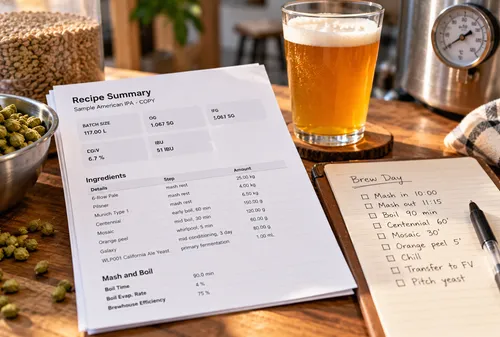
Finally, we talked about the recipe.Having a clear recipe allows you to follow proper execution guidelines once you move into the more complex part: the batch itself.I suggested that starting with three different styles can be very useful because each beer forces the brewer to learn different processes.
A lager teaches yeast care, cold crash, patience during maturation, cleanliness, and precision. It is a style where any off-flavor becomes much more noticeable.
An IPA helps refine hop techniques such as dry hopping, whirlpool additions, and the use of different hop formats: whole flower, extracts, pellets, and cryo hops.
A stout helps the brewer understand malt complexity, body, density, roasted grains, and pH control.We also talked about water adjustments, different yeast strains, and how to scale a recipe.My goal was to help brewers avoid some of the most common mistakes:
- Trying to perfect a recipe without understanding process or cleaning.
- Not controlling cold-side temperatures and timing.
- Taking oxygen exposure lightly.
- Using ingredients in poor condition and assuming nothing will happen.
- Creating overly complex recipes instead of starting with simple recipes and solid processes.
In the end, brewing is about process, cleaning, and creativity.It is a craft that must be built through experience, discipline, and constant learning.